A fusion start-up says it has turned mercury into stable gold. Mined diamond prices have roughly halved since 2022 as lab-grown stones spread, but gold's value rests on supports diamonds never had, and its real exposure is the opposite of the one the analogy suggests.
Introduction
On 21 October 2026 Marathon Fusion, a San Francisco fusion start-up, posted on X that it had "demonstrated high-rate alchemy: turning mercury into real, stable gold, beating CERN's record by a factor of 10". The post came with no experimental data. Within a day crypto investors were reading it as a forecast. Jesse Eckel, a crypto market analyst, wrote that "lab grown gold will eventually happen and be cheap just like diamonds". Tushar Jain of the crypto fund Multicoin Capital asked on X what lab-grown gold could do to gold prices, given what lab-grown diamonds did to diamond prices.
A wholesale index of lab-grown diamond prices kept by the analyst Edahn Golan is down 96% since 2018, and in May 2025 De Beers, which calls itself the world's leading diamond company, announced it would close Lightbox, its own lab-grown brand. Gold sits on a stock of 220,700 tonnes, worth about $31 trillion and held as jewellery, bars, coins and central-bank reserves. That raises the question of whether manufactured gold, made by nuclear transmutation of another element, would do to gold what lab-grown stones did to diamonds, and whether the money would move to Bitcoin.
What lab-grown stones did to diamonds, and why diamonds were exposed
Lab-grown diamonds are carbon crystals grown in reactors, the same material as mined stones, and their price fell with their production cost. In May 2018 a one-carat synthetic cost about $4,200 against about $6,000 for a mined stone, and De Beers soon began selling at $800 a carat. By the first quarter of 2026 a three-carat lab-grown round of top colour traded at $126 a carat, and wholesale prices had fallen 90% since 2019 on the analyst Paul Zimnisky's figures.
Zimnisky reports natural prices essentially cut in half since early 2022. The International Monetary Fund (IMF) found that Botswana's economy contracted by 3% in 2024, after diamonds, about 80% of its exports from 2012 to 2023, lost demand to "increased competition from artificial diamonds and alternative luxury spending, and lower demand from China". Lab-grown stones won volume more than value, carried by 61% of 2025 engagement rings in The Knot's survey of US couples but only about 15% of total diamond sales by value on the analyst firm Tenoris's estimate. Rapaport's one-carat natural price index then rose in August and again in September 2026, a second consecutive monthly gain, so natural diamonds were damaged rather than destroyed.
Diamonds' value was a flow of new stones, sold into a custom that the advertising agency N.W. Ayer had promoted since 1938 and in 1947 called "a problem in mass psychology", with no central bank holding diamonds and resale returning about half of the price paid. A lab-grown stone can still be told apart, since the US Federal Trade Commission (FTC) requires a "laboratory-created"-type disclosure and De Beers' screening machine sorts stones into "natural, synthetic (lab grown), or refer". Those two conditions, a value held in a flow and a manufactured stone that can be told apart, left diamonds exposed on price but with a natural tier to defend, which raises the question of how gold compares on each.
Why gold is harder to replace, and the one way it is more exposed
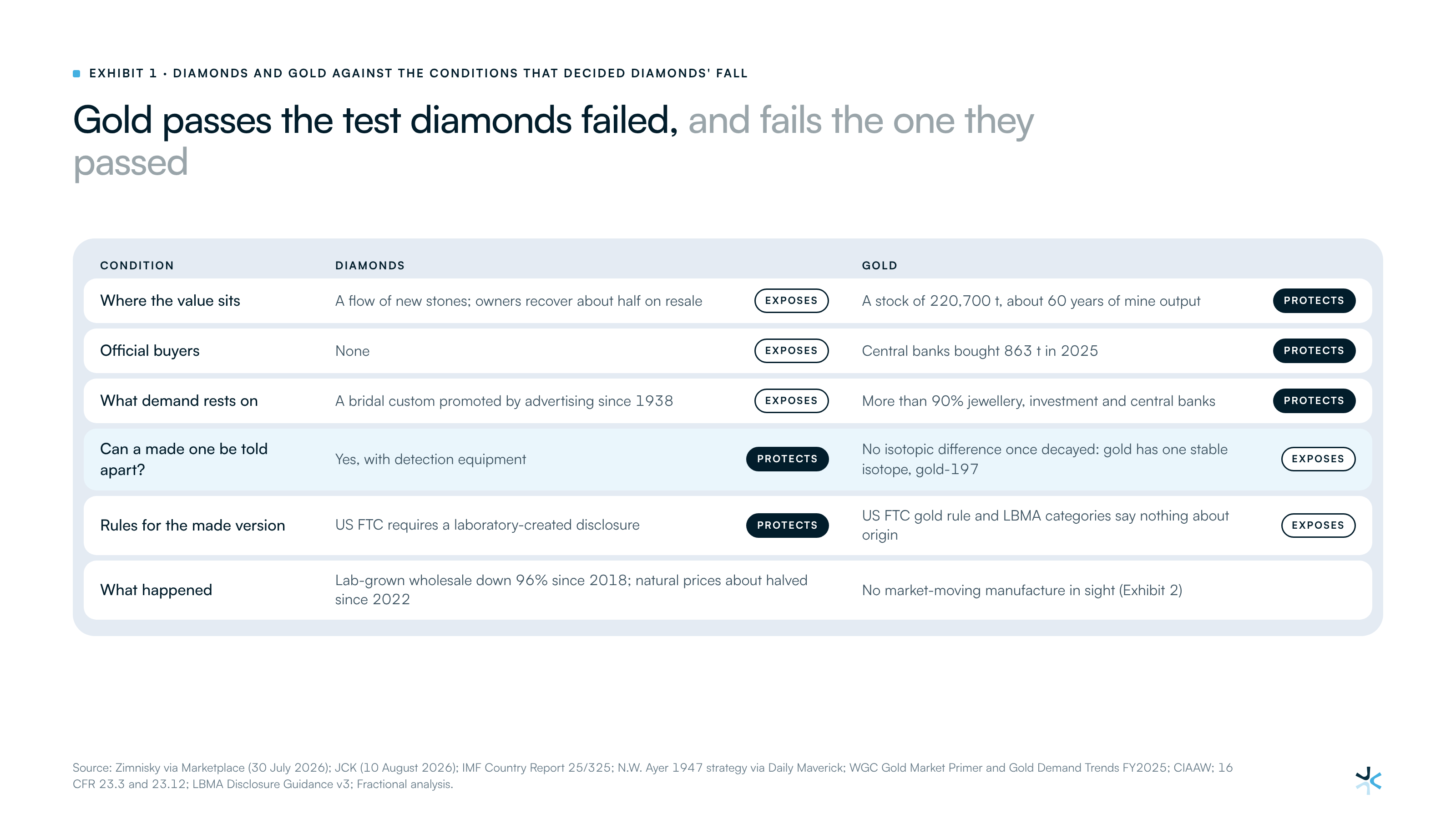
Gold's above-ground stock equals about 60 years of the 3,671.6 tonnes mined in 2025, and more than 90% of 2025 demand came from jewellery, investment and central banks. Central banks bought 863 tonnes in 2025 after more than 1,000 tonnes a year from 2022 to 2024, and a record 45% of those surveyed by the World Gold Council (WGC), the industry's market body, expect to add more. Gold also carries a culture that diamond marketing had to manufacture, with bridal jewellery at 50 to 55% of Indian jewellery demand across 11 to 13 million weddings a year. Indian households hold between about 25,000 tonnes on a 2019 WGC estimate and 34,600 tonnes on Morgan Stanley's June 2025 estimate. On where its value is held, gold is the opposite of diamonds, with its value held in a stock that official buyers keep adding to.
CERN's collider experiments made about 86 billion gold nuclei, just 29 picograms in the LHC's 2015 to 2018 run, which existed for a fraction of a second. Glenn Seaborg's 1980 experiment at Lawrence Berkeley Laboratory made gold at a cost he put at "more than one quadrillion dollars per ounce". Marathon's own 2025 preprint, which is not peer-reviewed, models about 2 tonnes of gold per gigawatt of thermal power a year from mercury enriched to 90% mercury-198. On the paper's own arithmetic, matching its 3,300-tonne figure for mine output would take 1.65 terawatts of fusion, or about 1.84 terawatts at 2025's 3,671.6 tonnes. Either is more thermal capacity than the world's fission fleet, whose 377 gigawatts of electricity come from about 1.1 terawatts of heat. Manufacture is therefore a high barrier on present evidence.
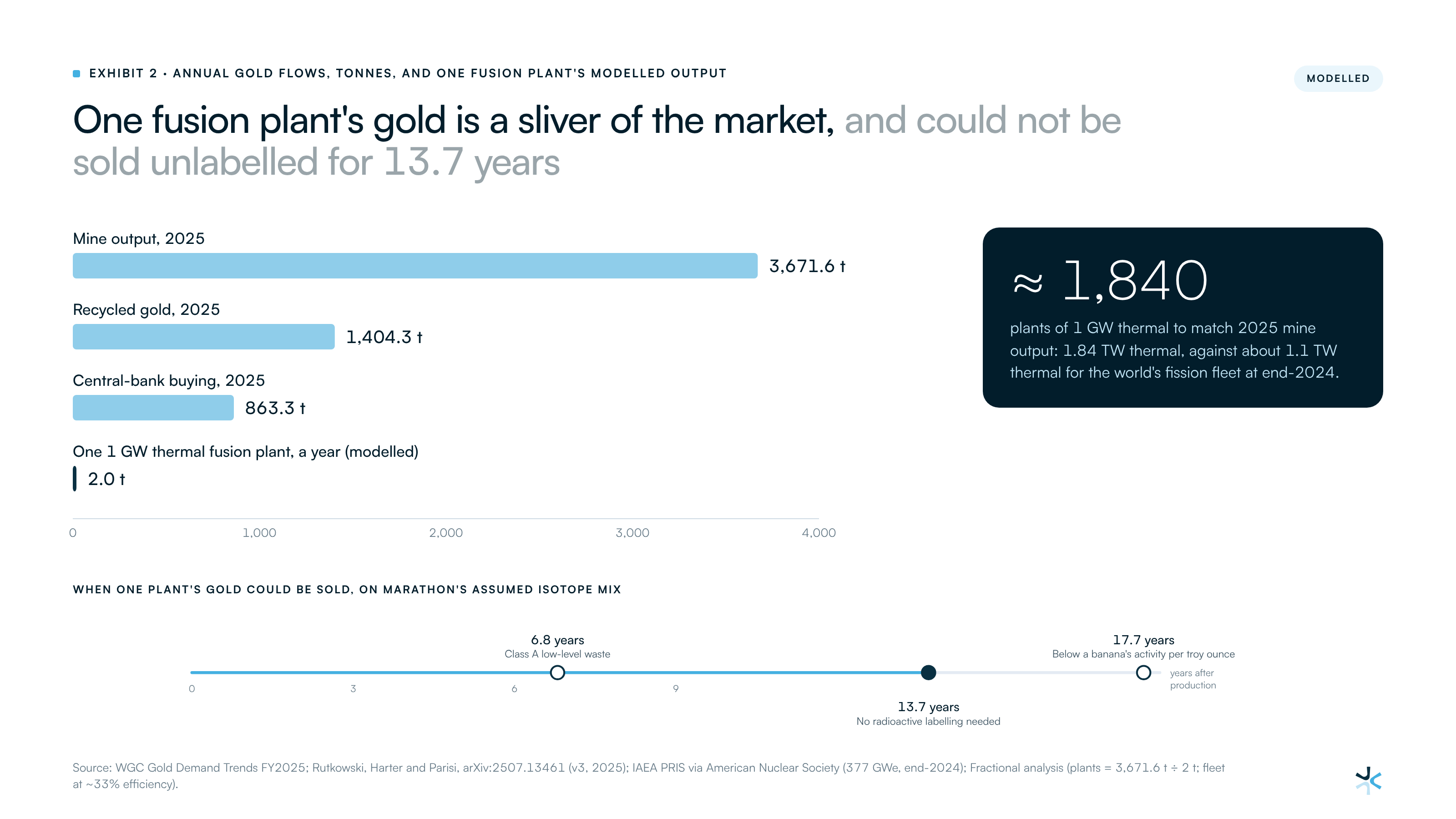
The same paper puts the gold obtainable from existing US and European mercury stockpiles at about 1,400 tonnes in total. Adrian Bevan, a physicist at Queen Mary University of London, notes that its simulation "needs to be validated against a real commercial fusion reactor – but none currently exist". On Fractional's arithmetic, ten times CERN's record would be about 0.3 nanograms if Marathon means CERN's 2015 to 2018 total, or about 9 nanograms a year of continuous running if it means CERN's peak rate. The company has not said which.
Gold has a single stable isotope, so that "its atomic weight is determined solely by its isotope 197Au", and fusion gold that has outlasted its radioactive impurities would be the same nuclide as mined gold. The FTC's gold rule regulates fineness and not origin, and the LBMA, which sets standards for the London bullion market, defines only mined and recycled gold. No published test shows whether decayed fusion gold could be detected, and nothing here should be read as claiming it could not. On whether a made ounce could be told apart, gold is more exposed than diamonds, which is the risk the diamond analogy hides.
Natural pearls and rubies kept a premium over made versions that could be detected, although natural pearl prices first crashed in the Depression, and a natural ruby sold for $34.8 million in 2023 after a century of synthetics. Aluminium, "more valuable than gold" in the mid-1800s, fell to about 30 cents a pound once a new process made the identical metal common. If manufacture ever became cheap and abundant, gold would follow aluminium rather than pearls, so its protection is the cost and scale of making it, not its identity.
The case for a wipeout, and for Bitcoin
Peter Earle, an economist at the American Institute for Economic Research (AIER), has argued that cheap, stable synthetic gold could cut prices "50 to 80 percent" and recast gold "as an industrial or luxury commodity". Hakan Kaya of the asset manager Neuberger Berman said that in such a world gold's scarcity value "to a certain extent gets destroyed", although he expected gold to keep working as a store of value. The case for a collapse is therefore made beyond crypto circles.
Bitcoin's advocates point to a supply that cannot be manufactured, since the 21 million cap is written into Bitcoin Core's code, 95.7% of it has already been mined, and Eckel wrote that "There will never be lab grown $BTC". Private money has followed, with US spot bitcoin exchange-traded funds holding $106 billion, and 73% of 351 institutions in a survey sponsored by Coinbase, a crypto exchange, plan to raise digital-asset allocations in 2026. Bitcoin's 90-day correlation with gold reached 0.55 in mid-September, the highest in Block Scholes' data since 2014, although the analysis stops short of showing bitcoin replacing gold as a haven.
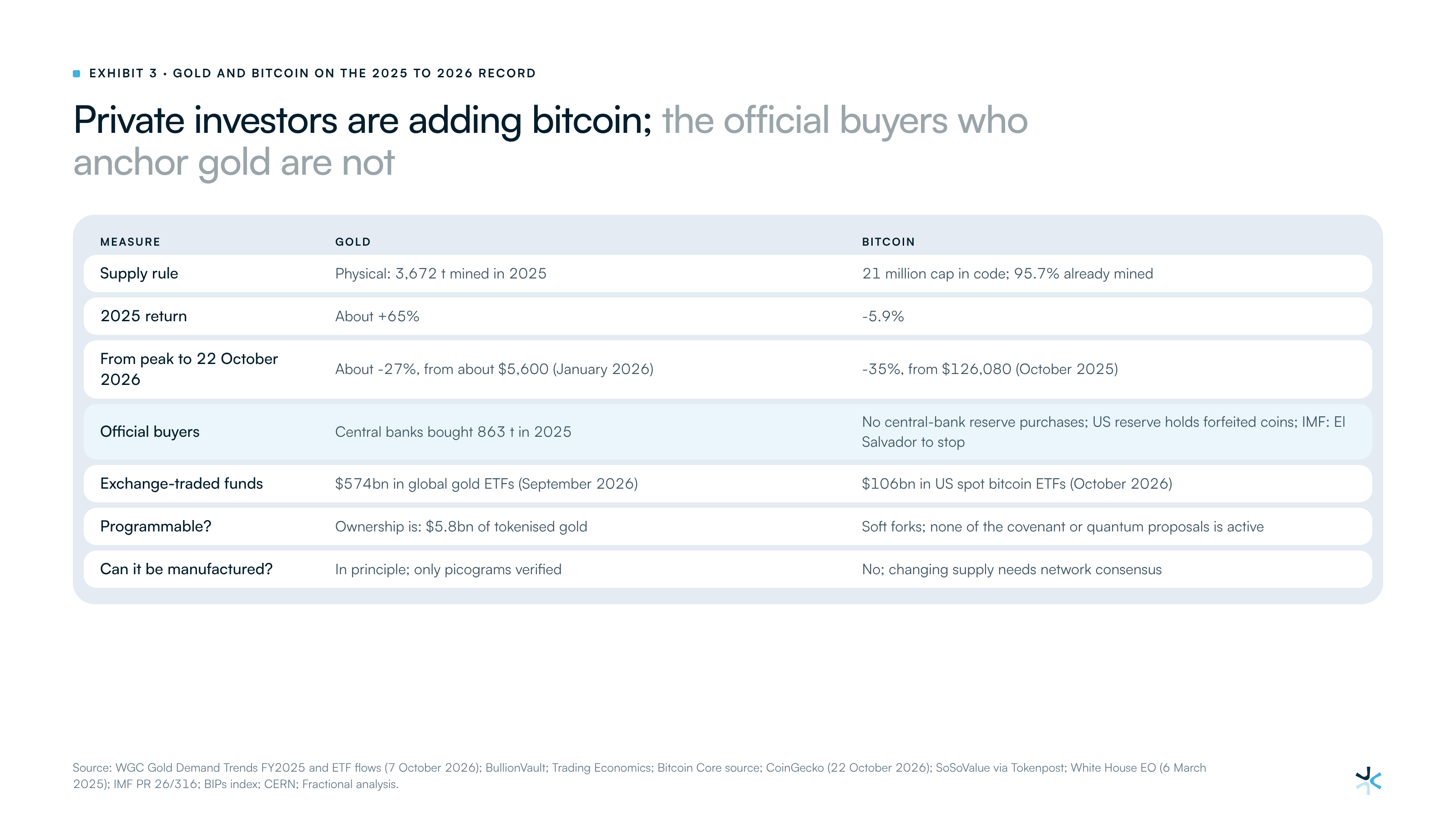
The IMF agreed with El Salvador that "No further Bitcoin accumulation is envisaged beyond the documented donations", and the US Strategic Bitcoin Reserve holds only forfeited coins. The Czech National Bank's purchase was a test portfolio outside its reserves, and Martin Schlegel, chairman of the Swiss National Bank's governing board, ruled bitcoin out partly because "software can have bugs". In 2025 Bitcoin fell 5.9% while gold gained 65%, and the official buyers who anchor gold's price have not moved towards it.
The covenant proposals that would add contract features remain drafts or inactive, and the quantum-resistance debate could restrict some 6.9 million coins held at vulnerable addresses. Gold's ownership, meanwhile, is already programmable through $5.8 billion of tokenised gold, a market the WGC says has grown fivefold since late 2024. The contrast between an upgradable Bitcoin and a fixed gold holds for the metal, but not for how it is owned.
Conclusion
Manufactured gold, which crypto investors call lab-grown gold, does not threaten gold's market on any timeline the evidence shows, and the diamond precedent that suggests otherwise was a halving, not a wipeout. Gold's value rests on a stock 60 years deep, on central banks that bought 863 tonnes in 2025, and on customs from Indian weddings to household savings that diamond marketing had to build. What survives of the alarm is narrower. A made ounce would be the same nuclide as mined gold once decayed, and no published test shows it could be told apart. Gold therefore has no natural tier to retreat to, and its protection is the cost and scale of manufacture and the continued demand of official buyers.
A wipeout would become plausible only if gold could be made below mining cost at terawatt scale, or if central banks stopped buying, and neither is in prospect. Any shock to expectations would land first on those who live from gold: Burkina Faso, where mining is 83% of exports, Mali, where gold is nearly 80%, and the 15 million artisanal miners whose work supports about 100 million livelihoods. Bitcoin is drawing private capital, but not the official buyers that hold gold's floor.